Planning
Skipper or bareboat? Choose the charter your crew will actually enjoy
Compare responsibility, privacy, space and full trip cost before deciding between a professional skipper and a bareboat yacht charter.
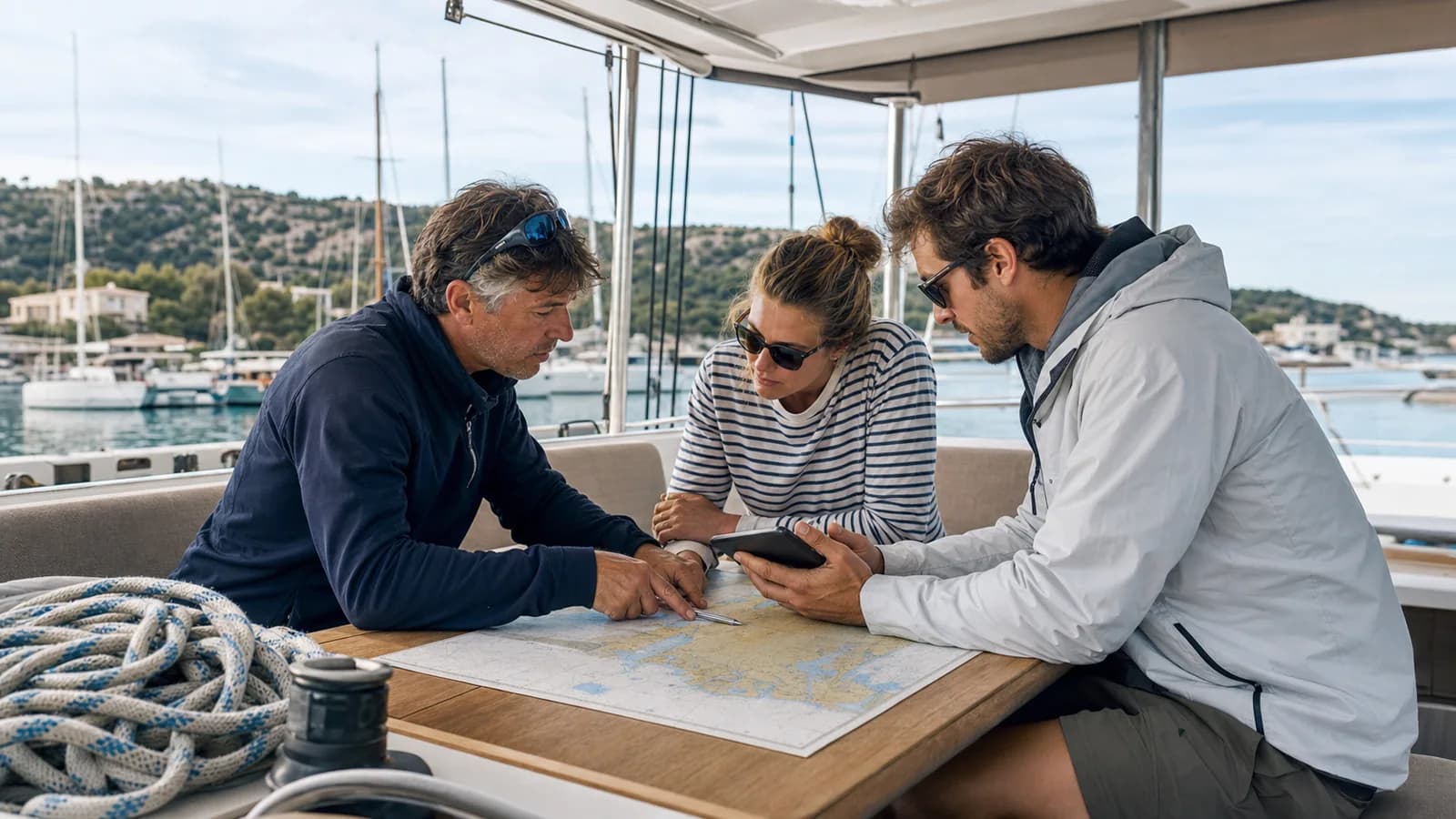
Bareboat feels independent when skipper and crew are ready, but can turn one person’s holiday into constant responsibility. A professional shifts formal command away from a guest, yet does not automatically provide cooking, childcare, guiding or harbour access. The right format is the one whose trade-offs everyone understands before paying.
The short distinction
Bareboat means the charterer’s approved skipper commands and operates the yacht without professional crew supplied for the trip. The operator normally reviews qualifications and experience, and local law may require specific evidence. The guest skipper plans passages, monitors weather, briefs the crew and manages routine manoeuvres and incidents.
Skippered charter adds a professional to command and navigate the yacht under the agreed product and contract. Guests can often participate, but safety decisions remain with the professional skipper. Depending on the operator, the group may need to reserve a suitable cabin and provide meals or provisioning. A skipper is not necessarily a host or chef.
Crewed charter is a different product again. It can include roles such as chef or host and may follow a different service model. Do not assume that adding one skipper turns a bareboat into a fully crewed holiday.
Start with responsibility, not confidence
Ask the proposed bareboat skipper to describe their recent experience, not whether they “feel confident”. Useful details include:
- days recently spent as skipper rather than as crew;
- largest comparable monohull, catamaran or motor yacht handled;
- close-quarters work in crosswind and busy marinas;
- anchoring, reefing, route planning and marine-radio practice;
- experience in the proposed weather, tidal or mooring environment;
- another adult’s ability to take basic control in an emergency.
A licence can be required and still be insufficient evidence of readiness for a particular boat. The RYA describes the ICC as evidence of competence when requested in relevant foreign contexts, not as a worldwide guarantee of acceptance. Operators also assess the yacht, destination and sailing résumé. Send the exact documents and obtain approval in writing before relying on bareboat.
Our first bareboat charter checklist goes deeper into documents, handover and safety preparation.
What changes aboard
| Question | Bareboat | Professional skipper |
|---|---|---|
| Who commands? | The approved guest skipper | The contracted professional skipper |
| Who plans around weather? | Guest skipper, using current sources and boat limits | Professional skipper, with guest preferences considered where safe |
| Who handles ordinary sailing? | Guest skipper and crew | Skipper; guest participation depends on the agreement and conditions |
| Does the group keep every berth? | Usually, subject to yacht layout | Not always; a suitable skipper cabin may be required |
| Are meals included? | Guests arrange their own | Often not; skipper provisioning terms vary |
| Is cooking/hosting included? | No professional service | Not merely because a skipper is present |
| Is the route guaranteed? | No | No; weather, safety, restrictions and yacht limits still control |
This table describes common distinctions, not legal terms. The offer and charter agreement are authoritative.
The real cost comparison
A fixed statement such as “a skipper costs €X per week” ages badly and hides the larger trade-off. Compare complete trip totals for the same dates and usable guest capacity.
For bareboat, include:
- yacht price and every mandatory operator charge;
- security-deposit method or any optional deposit product;
- training or refresher time you genuinely need before departure;
- travel decisions created by a specific base or check-in schedule;
- the personal cost of one guest being on duty as skipper.
For a skippered option, add or clarify:
- skipper fee and applicable taxes;
- cabin and bathroom arrangement;
- whether advertised guest capacity changes;
- meals, drinks or a provisioning allowance;
- travel or transfer costs for the skipper, if the terms require them;
- any gratuity custom, without treating it as a compulsory hidden charge;
- security-deposit and damage terms when a professional is aboard.
One operator may bundle certain items while another lists them separately. Even within the same company, destination and yacht layout can change the arrangement. Compare the final written offer rather than multiplying a daily figure found on an old blog.
Space and privacy are not footnotes
On a four-cabin catamaran, giving one cabin to the skipper can materially change the holiday. A forepeak may or may not be suitable or permitted for professional accommodation; never assume it solves capacity. Check the precise layout and the operator’s rule before inviting the maximum number of guests.
Privacy is more nuanced than “a stranger on board”. A good pre-charter conversation can establish quiet time, meals, shore leave and how guests want to participate. Still, a professional lives and works in the same compact space. If the crew’s central wish is complete family privacy, that trade-off deserves full weight.
Bareboat creates a different privacy cost: the guest skipper may never be fully off duty. They remain alert to weather, anchor position, batteries, water, fuel, route and return time. Ask whether the group is comfortable with that person overriding a popular plan for safety.
What a skipper normally is—and is not
A professional skipper’s central work is safe command, navigation and operation of the yacht. They may bring local knowledge and help shape a sensible route, but “local knowledge” does not create a berth, override protected-area rules or guarantee a particular island.
Unless the product explicitly includes more, do not assume the skipper will:
- cook and clean for the group;
- supervise children or non-swimmers;
- act as a round-the-clock concierge;
- teach a certified course;
- arrange every restaurant, transfer or berth;
- accept an unsafe route because it appeared in the original enquiry.
Ask what ordinary guest participation is expected. Some skippers welcome hands-on sailing; others may need crew assistance during mooring even when they command the yacht. The Moorings’ current skipper FAQ, for example, distinguishes its packaged skippered charter from a skipper added to a bareboat: accommodation and provisioning differ between those products. Dream Yacht’s current product information likewise notes a skipper cabin. These are concrete operator examples, not universal rules.
Five decision tests
1. The operator-approval test
Would the operator approve the proposed bareboat skipper’s exact qualifications and recent experience for this exact yacht and destination? “Probably” is not enough. Obtain a written response.
2. The 03:00 test
Who will assess a changing wind, an anchor alarm or an electrical problem in the middle of the night? If the nominated skipper resents being that person, bareboat may not match the desired holiday.
3. The marina test
Can the skipper direct this particular crew calmly during a difficult approach? A certificate holder plus six first-time guests is a different team from three recently practised sailors.
4. The cabin test
After allocating a proper berth to a professional, is the yacht still comfortable and within its permitted capacity? If not, compare a larger yacht or bareboat readiness rather than improvising sleeping arrangements.
5. The disagreement test
Will everyone accept a safety-led change of route? A professional skipper should not be hired merely to validate a fixed itinerary. A guest skipper should not be pressured because friends paid for a particular island.
Hybrid options: useful only when explicitly offered
Some operators offer a professional skipper for the first part of a trip, a sail-guide product, tuition, or a flotilla format. These can bridge a real gap, but the names do not mean the same thing across companies.
A first-day briefing is not beginner training. A handover explains the yacht and records its condition; it cannot build years of close-quarters judgement in an afternoon. Likewise, hiring a skipper for two days only helps if the operator permits the arrangement, the professional judges the guest ready to take over, and the contractual responsibility transfer is clear.
Ask exactly when command changes, who approves it, what qualifications remain necessary and whether the insurance terms change. If no written hybrid product exists, choose between the actual bareboat and skippered offers instead of inventing one.
Illustrative decision example
Illustrative only: two couples and two teenagers want a one-week catamaran. One adult holds a relevant certificate and has recently skippered smaller monohulls, but has little twin-engine catamaran experience. The destination uses tight stern-to moorings, and nobody else can confidently take command.
The group first compares only the skipper fee. Then it includes the lost guest cabin, a potentially larger yacht, skipper meals and the fact that the nominated guest wants a holiday rather than a skills test. They request two written offers: one skippered yacht with a valid sleeping arrangement, and one smaller bareboat subject to operator approval. They also ask whether a genuine training or partial-skipper product exists.
If the operator declines the bareboat résumé, the group does not shop around for a less careful answer. It chooses the professional format or a different boat and region. This example does not prove that a skipper is always safer or better; it shows how capacity, crew resilience and recent experience belong in the same decision as price.
Questions to settle in writing
For either format, confirm:
- exact yacht and permitted guest capacity;
- included and mandatory charges;
- cancellation, amendment and substitution rules;
- check-in, handover and return times;
- navigation limits and operator support process;
- deposit collection, damage reporting and release.
For bareboat, add accepted skipper and radio documents, experience approval and any competent-crew requirement.
For a professional skipper, add fee, taxes, sleeping space, bathroom, meals, travel, working language, expected guest assistance, arrival/departure times and the scope of duties. Ask what happens if the assigned professional becomes unavailable; do not infer a guaranteed replacement beyond the contract.
The Charterwerk booking process explains why an enquiry, payment and written operator confirmation are separate stages.
Choose the holiday, then choose the yacht
Choose bareboat when the operator approves the documents, the skipper has relevant recent experience, another adult can assist and the skipper genuinely wants command. Choose a professional skipper when the crew lacks that readiness, the destination or yacht adds too much novelty, or everyone—including the nominated sailor—would enjoy the trip more without guest command.
Then search yachts with the right guest capacity, remembering to reserve appropriate space for any professional crew. To understand Charterwerk’s role in organising the comparison, read About Charterwerk.
Sources and further reading
- RYA: the purpose and limits of the ICC
- RYA: passage planning and crew capability
- Sunsail: operator-specific experience and licence requirements
- The Moorings: current skippered-charter product distinctions
FAQ
Does an ICC guarantee bareboat approval?
No. Acceptance depends on applicable law and the operator’s assessment of the certificate, yacht, destination and experience. Obtain approval in writing before booking around it.
Continue your planning
Reviewed guides for the practical questions that usually come next.
Families
A yacht charter with children: a practical family decision guide
Plan a family yacht charter around supervision, correctly fitted safety equipment, boat layout, weather margin and routines that children can actually sustain.
Booking clarity
Yacht charter security deposits and damage waivers explained
Understand card holds, paid deposits, damage waivers and separate deposit insurance before a yacht charter—without assuming that the product name defines the cover.
Booking
Yacht charter cancellations, changes and insurance: a decision guide
Understand which contract controls a cancellation or change, what travel insurance may assess, and which evidence to collect before making an expensive decision.
Turn the guide into a shortlist
Compare current yachts first, then ask us to clarify operator wording before you commit.