Destinations
Croatia yacht charter guide: choose a base, pace and route
Plan a first Croatian charter around the right departure region, realistic sailing days, weather alternatives, skipper documents and berth strategy.
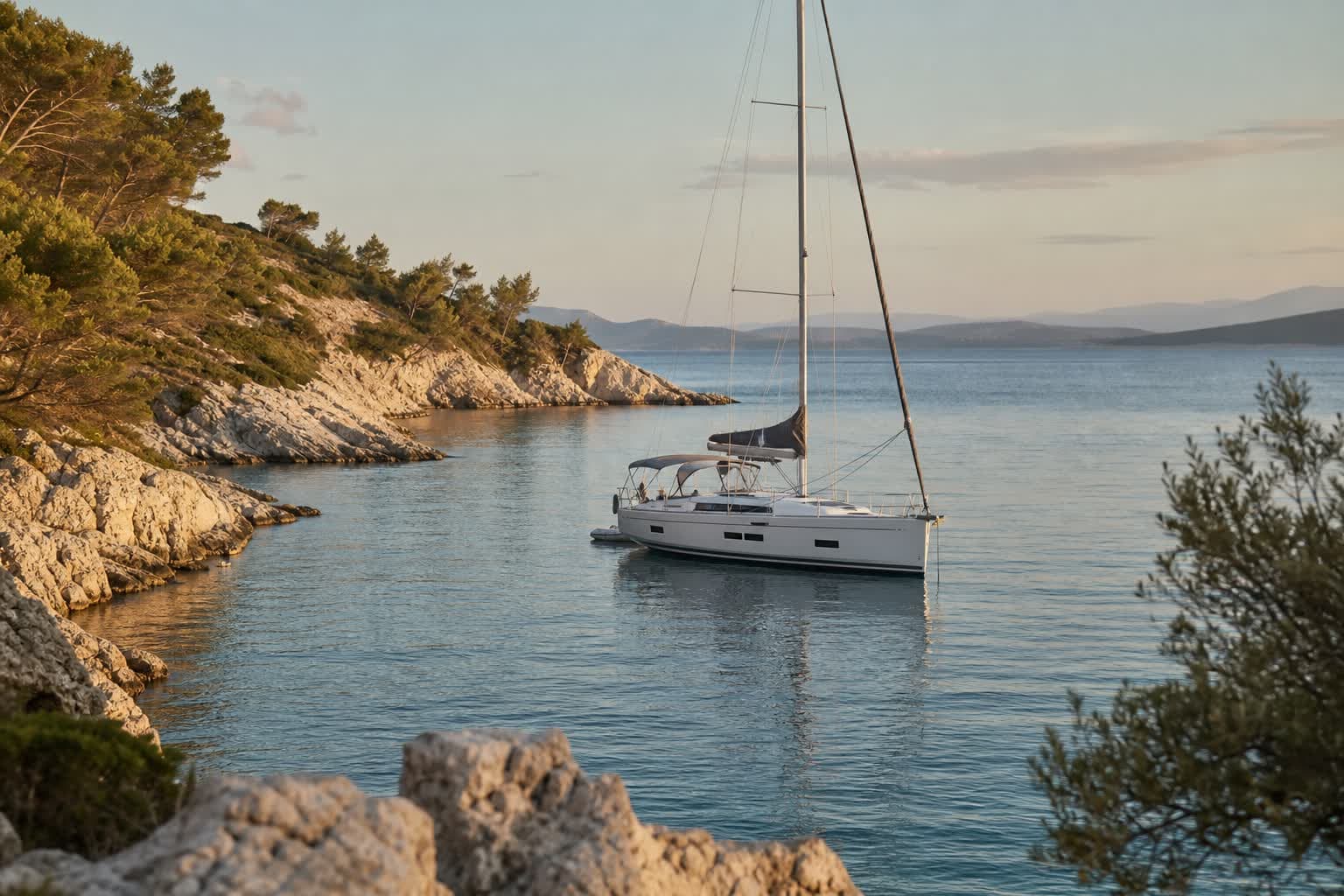
Croatia is easy to shortlist and surprisingly easy to over-plan. Islands are close on a map, charter bases are plentiful and there is often another attractive stop around the next headland. The real choice is not “Croatia or somewhere else” but which part of the coast matches your crew, travel connections and appetite for changing berths.
This guide helps you choose a starting region and build a week with enough margin to react to wind, crowds and the pace of the people aboard.
Choose the departure region first
Split and the central Dalmatian islands
Bases around Split, Trogir and Kaštela put Brač, Šolta, Hvar and Vis within the planning conversation. The area suits crews that want recognisable island towns, many operator choices and a mix of marinas, town quays, buoy fields and anchorages.
Popularity is the constraint. A route that depends on one famous harbour every evening can become a race for space. Plan alternatives on both sides of each island and decide whether nightlife or a quiet swim stop matters more.
Šibenik and the nearby archipelagos
The Šibenik area gives access to the islands toward Kornati as well as the Krka estuary. It can suit a crew that prefers shorter steps, intricate island scenery and fewer headline destinations.
Protected-looking water still requires careful navigation. Passages, park rules, berth systems and local winds deserve preparation. Confirm whether park entry or mooring is included anywhere; do not treat a general charter price as covering it.
Zadar and northern Dalmatia
Zadar, Sukošan and Biograd can support routes toward Dugi Otok, the Kornati area and numerous smaller islands. There is plenty of choice, which makes it tempting to draw a long loop.
Keep the western side of exposed islands and the return leg conditional on the forecast. A route with an inside alternative is more useful than a beautiful fixed line that only works in one wind direction.
Istria and Kvarner
Northern bases can work well for crews arriving by road from central Europe and for trips focused on Istrian towns, Cres, Lošinj or nearby islands. Distances and exposure differ from the dense central-Dalmatian island groups.
This is not simply a quieter version of Split. Review open-water legs, bora exposure and seasonal base services with the operator. Choose it because the region itself fits, not only because the drive is shorter.
Dubrovnik and southern Dalmatia
The south offers routes toward the Elafiti islands, Mljet and Korčula, with Dubrovnik as a powerful beginning or end to the land portion of a holiday. It can suit crews that want fewer but more deliberate stops.
One-way charters may appear attractive, but confirm availability, delivery cost, check-in logistics and the exact return location. Do not assume that reaching a different base removes the need for weather margin.
Understand the usable week
A Saturday-to-Saturday charter often includes check-in during the first afternoon and a requirement to return to the base on Friday evening, even if final check-out is Saturday. Your contract and base instructions control. The practical result can be five full route days plus two short legs.
Build the route backward:
- record the required return time and refuelling process;
- choose a safe final-night area within an easy distance;
- keep the most exposed or longest leg out of the final day;
- identify a midpoint where you can shorten the loop without losing the holiday;
- make the first leg simple enough for handover delays.
If the crew wants time ashore, avoid counting every day as a passage day. Two nights in one place can be a feature rather than a planning failure.
A seven-night central-Dalmatia framework
This is not a prescribed itinerary. It shows how to build choices around a Split-area return.
Arrival day: base to a nearby protected stop
Complete the handover carefully and choose a nearby berth or anchorage that can be reached in daylight. Use the short leg to test instruments, reefing, engine response and crew roles. If the handover runs late, staying at the base can be the correct decision.
Early week: Šolta or Brač
Choose the island and side according to the forecast, not a saved social-media list. One day can combine a modest passage, swim stop and a town or quiet bay. Verify depths, holding, local mooring arrangements and restaurant-buoy conditions from current sources.
Middle of the week: Hvar area or an alternative
If the crew wants Hvar Town, decide how much uncertainty and activity you accept. A berth elsewhere with a land connection may be more relaxed than making one harbour the only acceptable outcome. The Pakleni islands can be part of the plan, but protection varies by position and conditions.
Furthest point: only with a return margin
Vis is attractive, yet it makes the route longer and more exposed than an inner-island week. Add it only if the boat, crew and forecast support the outward and return legs. Otherwise use the time for deeper exploration around Brač, Šolta and Hvar.
Final two days: move back inside the return radius
Do not leave the longest leg for Friday. Position the boat so an unfavourable morning forecast does not force a rushed return. Confirm refuelling queues and base instructions, then arrive with enough time to report defects and complete the return inspection.
Weather patterns to respect
The maestral is a common fair-weather afternoon sea breeze, but it is not a guaranteed daily timetable. Bora can produce strong, gusty offshore flow, while jugo brings a different build-up and sea state. Thunderstorms can change local conditions quickly.
Use the official DHMZ marine forecast, the base briefing and appropriate navigation weather sources. Check warnings more than once a day. A general tourism forecast is not sufficient for deciding whether a small craft should leave.
Ask the operator which nearby areas behave differently in the expected wind and what local warning signs matter. The skipper remains responsible for choosing a safe plan.
Skipper documents and crew details
Recognition changes and depends on the certificate and boat. Before booking bareboat, consult the Croatian Ministry’s current nautics information and recognised-certificate documents, then send the exact certificates and recent experience to the operator for written approval. Check whether a radio certificate is required.
Provide the crew list by the requested deadline with names matching identity documents. Ask how changes are handled. Keep the operator confirmation, charter documents, crew list and emergency contacts accessible aboard.
Berths, buoys and anchorages
Treat each night as a choice between different trade-offs:
- a marina offers services and easier access ashore but may cost more and fill early;
- a town quay places you in the centre but can be busy, exposed or operationally demanding;
- a managed buoy may reduce anchoring work but still requires checking tackle, protection and payment terms;
- an anchorage gives flexibility only when depth, holding, swing room, rules and conditions are suitable.
Reservation systems and prices change. Confirm the exact season, yacht dimensions and cancellation policy directly with the facility. Never rely solely on crowd-sourced availability.
What to settle before paying
Ask for written answers on:
- exact yacht and whether images show that boat or a sister ship;
- accepted skipper documents;
- mandatory extras and what is payable at the base;
- security-deposit collection and release;
- check-in and required return times;
- navigation restrictions and cross-border permissions;
- tender, outboard, bedding and towels;
- technical support outside office hours;
- operator cancellation and change rules.
A clear Croatia booking should leave you with choices, not a rigid chain of famous stops.
FAQ
Is one week enough for a Croatia charter?
Yes, if you choose one departure region and plan a modest loop. A week is not enough to “do Croatia,” and trying to collect distant highlights can remove the time and margin that make the holiday enjoyable.
Do I need to reserve every night?
Not necessarily. The right mix depends on season, crew and route. Reserve essential stops where possible, but retain safe alternatives because weather and availability can invalidate a fixed sequence.
Can the operator confirm whether my licence is accepted?
The operator must approve your documents for the booking, while Croatian authorities determine legal recognition. Check both and obtain the operator’s response in writing before committing to bareboat.
Continue your planning
Reviewed guides for the practical questions that usually come next.
Destinations
Sailing in Greece: choose the right region and a realistic route
Compare the Ionian, Saronic Gulf and Cyclades, then plan a Greek yacht charter around weather, crew confidence, ports and protected waters.
Families
A yacht charter with children: a practical family decision guide
Plan a family yacht charter around supervision, correctly fitted safety equipment, boat layout, weather margin and routines that children can actually sustain.
Booking clarity
Yacht charter security deposits and damage waivers explained
Understand card holds, paid deposits, damage waivers and separate deposit insurance before a yacht charter—without assuming that the product name defines the cover.
Turn the guide into a shortlist
Compare current yachts first, then ask us to clarify operator wording before you commit.