Costs and payments
Yacht charter costs explained: build the complete trip budget
Turn a headline weekly price into a realistic charter budget by separating mandatory charges, selected extras, payments at the base, deposits, fuel, berths and travel.
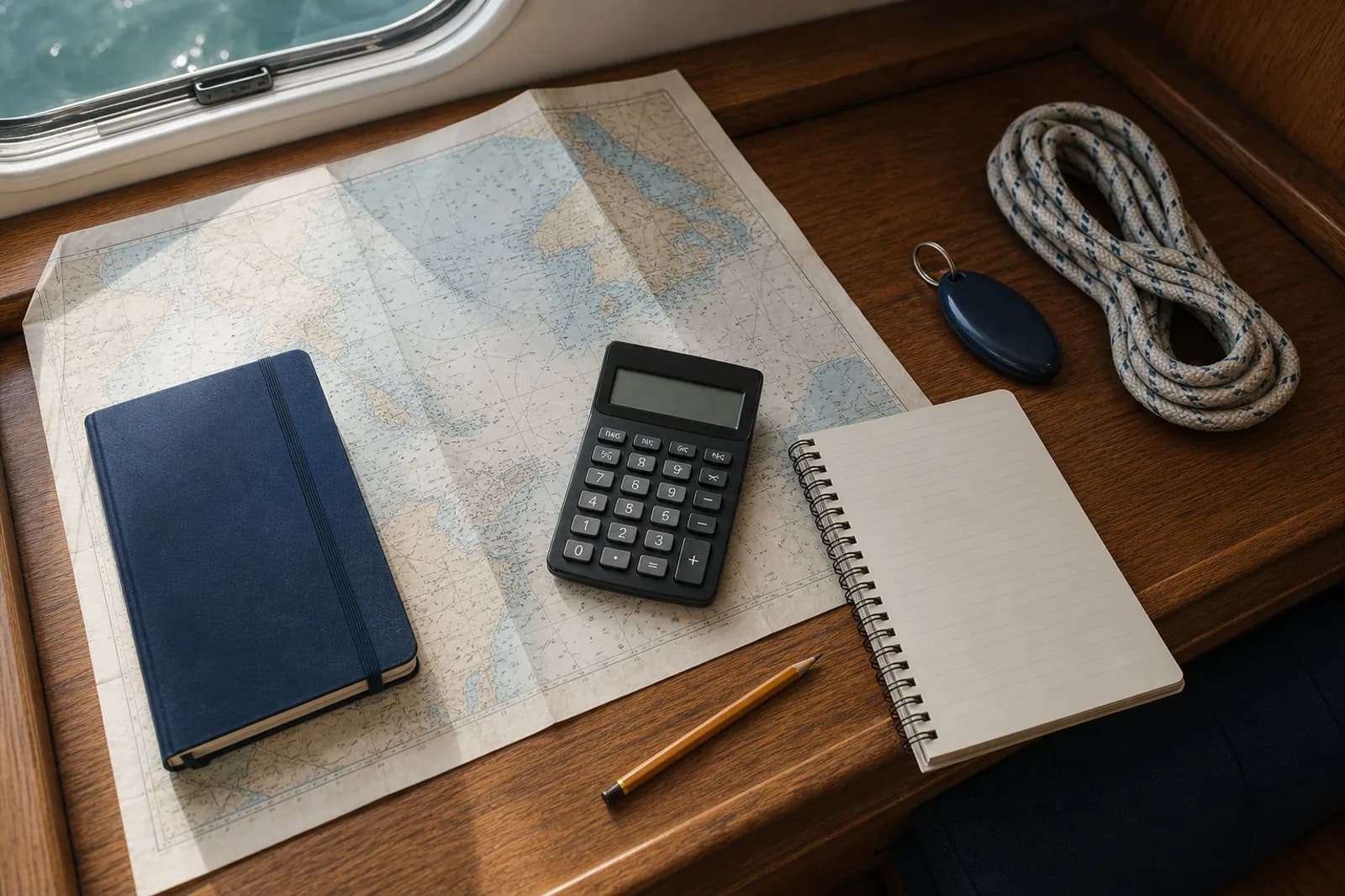
The weekly rental is only one line in a yacht-charter budget. The number becomes useful when you can answer four questions for every cost: is it mandatory, who receives it, when is it due and can the amount still change?
A trustworthy comparison uses the same categories for every boat. It also separates money you spend from a refundable security deposit, which affects available credit or cash even though it is not intended as a final cost.
Start with the charter price
The base charter price normally covers use of the specified yacht for the contracted period and the standard inventory stated by the operator. It does not automatically include every service shown in photographs or every cost needed to complete the holiday.
Check that the quote matches:
- the exact yacht or clearly disclosed equivalent;
- departure base and return base;
- check-in and check-out dates;
- selected discount conditions;
- tax treatment stated on the offer;
- bareboat, skippered or fully crewed service level.
If two offers differ, compare their inclusions before concluding that one operator is cheaper. A package price may already contain cleaning or linen that another operator charges separately.
Mandatory operator charges
Operators use different names for the services required with every booking: transit log, charter pack, comfort package, final cleaning or base fee. The label matters less than the contents and whether it is compulsory.
Ask for one itemised list showing what each charge provides. It may include cleaning, bedding, towels, cooking gas, initial outboard fuel, diver inspection, Wi-Fi or administrative handling. Do not add those items again if they are already in a package.
Confirm whether the amount is:
- included in the online total;
- payable in advance to the operator;
- collected at check-in by card or cash;
- calculated per booking, per person or per week.
An item described only as “payable locally” still belongs in your pre-booking budget.
Optional extras that become practical necessities
An extra can be optional contractually but important to your crew. Common examples include a professional skipper, hostess, safety net, extra towels, stand-up paddleboard, early check-in, transfer or provisioning service.
Before selecting one, verify availability for the exact dates, tax, payment recipient and cancellation conditions. For a professional skipper or crew member, also budget meals, an appropriate sleeping place and any agreed travel expenses. Adding crew can reduce the number of guest berths.
Treat early check-in as a request until the operator confirms it. Maintenance, yacht return and cleaning can affect whether it is possible.
The security deposit is a liquidity question
The refundable security deposit protects the operator against specified loss or damage under the charter contract. It may be pre-authorised on a card, charged, accepted in cash or replaced or reduced by a non-refundable insurance or waiver product.
Ask:
- the deposit amount and accepted card types;
- whose card and presence are required;
- whether it is a block or a charge;
- how long release normally takes after return;
- what evidence and process apply if the operator alleges damage;
- which exclusions remain under any waiver product.
A deposit waiver is not automatically comprehensive insurance. Read exclusions for tender, sails, blocked toilets, lost equipment, gross negligence or specific navigation areas. Compare the non-refundable premium and residual liability rather than the product name.
Do not count the full deposit as trip spending, but ensure the card limit can absorb it without blocking accommodation or travel purchases.
Fuel cannot be one universal number
Sailing yachts still use fuel for manoeuvring, charging and low-wind passages. Catamarans have two engines and may also run a generator. Motor-yacht consumption can vary dramatically with speed.
Build a range using the actual model and intended route. Ask the operator for realistic engine and generator consumption, tank policy and the fuel level expected on return. Then consider:
- likely engine hours under conservative assumptions;
- generator use for air conditioning or power;
- local fuel price at the time of travel;
- detours and return-to-base margin;
- tender outboard fuel.
For a motor yacht, request consumption at more than one speed. A route calculated only at fast cruise can produce a misleading budget and leave little weather margin.
Berths, buoys, parks and tourist charges
Overnight choices affect both cost and experience. Marina and quay prices can depend on season, length, beam, electricity and reservation channel. Catamarans may be charged differently because of their width. Managed buoy fields, national parks and tourist systems can have separate rules.
Estimate at least three scenarios:
- mostly anchoring with a few paid stops;
- a balanced mix of marinas, buoys and anchorages;
- a marina-heavy week.
Use current prices from the facility or authority, not an old forum post. If your crew requires shore power, easy access or guaranteed facilities, budget the realistic scenario rather than the cheapest theoretical one.
Food, water and life ashore
Provisioning is a trip cost even when everyone would eat at home. Separate onboard groceries from restaurants so the group can agree on style. Add drinking water if tank water is not suitable for everyone, ice, cleaning supplies and delivery fees.
Decide how shared spending works before departure. One crew member should not discover at the end that the others expected fuel, berths and the skipper’s meals to come from the original charter payment.
Travel and schedule risk
Flights, road tolls, parking, transfers and a hotel before or after the charter can materially change the comparison between bases. A cheaper yacht that requires difficult connections or a risky same-day arrival can cost more overall.
Consider arriving near the base the day before, particularly when the journey has multiple connections. Check what happens if the crew misses check-in; the operator is not normally responsible for disrupted travel arrangements.
Do not buy non-refundable travel solely because a card payment has succeeded. Wait for the written operator confirmation and check the yacht, dates and base on it.
A reusable budget worksheet
Create columns for “quoted,” “estimated range,” “recipient,” “due date” and “refundable.” Use these rows:
| Category | What to record |
|---|---|
| Charter | Base price, discount conditions, included tax |
| Mandatory package | Every compulsory operator item |
| Selected extras | Equipment, services and professional crew |
| Payments at base | Method, currency and recipient |
| Security | Deposit or waiver, residual liability |
| Operating | Fuel, water, shore power |
| Overnight | Marinas, quays, buoys, parks |
| Crew life | Provisioning, meals and skipper meals |
| Travel | Flights or driving, transfer, parking, hotel |
| Margin | A crew-agreed contingency |
Divide only the non-refundable expected total among travellers. Keep the deposit and each person’s private travel spending visible but separate.
How Charterwerk displays payment routes
The checkout should identify what is due, to whom and why. Depending on the operator connection, a payment may be processed through Stripe Connect for the operator, or Charterwerk may collect a clearly displayed reservation fee before providing instructions for the charter balance payable directly to the operator.
The offer and checkout for your booking are authoritative. If the recipient or remaining balance is unclear, pause and ask before paying.
FAQ
Is the cheapest weekly price usually the cheapest trip?
No. Mandatory packages, travel, berth needs, fuel and included equipment can reverse the comparison. Put every candidate into the same worksheet.
Is a security deposit part of the charter price?
It is usually refundable security rather than a final price, but it affects card limit or cash during the trip. A waiver premium, if chosen, is generally a non-refundable cost.
How much contingency should a crew keep?
There is no universal percentage. Agree on a margin based on route, transport flexibility, boat type and how marina-dependent the crew is. The important point is that the margin exists and everyone knows how shared costs are approved.
Continue your planning
Reviewed guides for the practical questions that usually come next.
Families
A yacht charter with children: a practical family decision guide
Plan a family yacht charter around supervision, correctly fitted safety equipment, boat layout, weather margin and routines that children can actually sustain.
Booking clarity
Yacht charter security deposits and damage waivers explained
Understand card holds, paid deposits, damage waivers and separate deposit insurance before a yacht charter—without assuming that the product name defines the cover.
Booking
Yacht charter cancellations, changes and insurance: a decision guide
Understand which contract controls a cancellation or change, what travel insurance may assess, and which evidence to collect before making an expensive decision.
Turn the guide into a shortlist
Compare current yachts first, then ask us to clarify operator wording before you commit.